Monday, March 2, 2009

POETRY - selected - CREATIVITY, BEAUTY

These poems were copied from A.J. Sayyáh's informative and discerning blog, available here.

The Candle

The Candle
By John Wiegley

The candle is a master at love.
He stands tall, and presents himself
before his lover.
He kindles a divine spark in the heart
and sets the core of his being
ablaze with devotion.
The temperature rises:
it burns him with sweet fire.
He begins to melt away
in thought of her;
he sighs in hot wisps
that rise on the air.

As he thinks of his beloved
he weeps away precious tears,
for he soon comes to realize
one of love's mysteries:
that truly to love,
the lover must disappear.

Thus, his hardened self yields to liquid,
then to fire, then to light.
He brightens her face by his feeble flame --
and she calls it romantic;
he grants her a moment's peace
in fighting off the shadows of the night.

And though he burns his life away,
what he is now, is his lover's delight --
for he has found the immortal Way:
her happiness is his happiness.

Ref: http://www.upliftingwords.org/poetry/Candle.htm

2008-07-17

This is faith

This is faith

To walk where there is no path,
To breathe where there is no air,
To see where there is no light,
This is faith.

To cry out in the silence,
The silence of the night,
And bearing no echo, believe,
And believe again and again,
This is faith.

To hold pebbles and see jewels,
To raise sticks and see forests,
To smile with weeping eyes,
This is faith.

To say "God, I believe." when others deny,
"I hear." when there is no answer,
"I see." though naught is seen,
This is faith.

And the fierce love in the heart,
The savage love that cries,
Hidden Thou art, yet there,
Veil Thy face and mute Thy tongue.
Yet I see and hear Thee, love
Beat me down to bare earth
Yet I rise and love Thee, love
This is faith.
By Amatu'l-Baha, Ruhiyyih Khanum

2008-07-13

Tahirih

TAHIRIH

Tahirih the pure one
Consolation of the eyes
What I would give to meet you now
While my life is new

You had the strength I pray for
The courage that life calls for
The Master that I too adore
Revealed Himself to you

In a dream He stood perfection
Your life it changed direction
You knew it then, your life would end
To glorify His name

Tahirih my sister
What right have I to call you so?
Unworthy of the dust beneath your feet
I am I know

With eloquence you stirred them
Your boldness it perturbed them
Your vision reached beyond their ken
To worlds your eyes behold

And your deed would be the trumpet blast
To shake foundations of the past
And lay the groundwork that would last
For centuries to come
You were all a woman
Could hope to attain
On this earthly plane

And my chosen path
Is the shadow you cast
In the brilliance of
His boundless love

Tahirih the letter
No friendly eye could bear your fate
No mortal tongue can thus relate
The evil done to you
You stood before your enemy
And held yourself with dignity

No man could match your bravery
Your final words were sure
And unknowing of your station
The point of adoration
Your crime they'd say with life you'd paid
Was a fearless love of truth.

2008-07-12

O Baha'u'llah!

O BAHÁ'U'LLÁH

O Bahá'u'lláh,
O Bahá'u'lláh, O Bahá'u'lláh
What hast Thou done?
O Bahá'u'lláh,
O Bahá'u'lláh, O Bahá'u'lláh
What hast Thou done?
May my life be sacrificed!
May my life be sacrificed for Thee
May my soul be offered up!
May my soul be offered up
for Thy sake

O Bahá'u'lláh,
O Bahá'u'lláh, O Bahá'u'lláh
What hast Thou done?
O Bahá'u'lláh, O Bahá'u'lláh
How full were Thy days,
how full were Thy days
With trials and tribulations!
How severe the ordeals,
how severe the ordeals
How severe the ordeals Thou didst endure!

O Bahá'u'lláh!
How solid the foundation
Thou hast laid
O Bahá'u'lláh!
How glorious the banner
Thou didst hoist
Bahá'u'lláh, Bahá'u'lláh
The glorious banner Thou didst hoist!
O Bahá'u'lláh
O what hast Thou done?
O Bahá'u'lláh!

Behold a Candle

Behold a Candle

Behold a candle
how it gives its light
it weeps it's life away
drop by drop to give it's flame
You must die to the world
and so be born again
and enter to the kingdom of heaven

Look at me, follow me,
be as I am, 'Abdu'l-Bahá,
Abdu'l-Bahá

You are the angels
if your feet be firm,
be steadfast as a rock
that no earthly storm can move
And as you have faith
so shall your powers be
and know that 'till the end
I'm always with you

Look at me.....
Love mankind.....

And how I long
to travel the world
in utmost poverty
and cry out "Ya Bahá"
God willing you may do this for me

Teach mankind....
Serve the cause....
Look at me..

Religions unite to pray for Iran's Bahá'í prisoners - UNITY & COOPERATION


An all-day Interfaith prayer vigil has been held in Edinburgh in support of the seven Bahá'í leaders being detained in Iran.

Six members of the Scottish Interfaith Council representing the Sikh, Bahá'í, Hindu and Buddhist faiths, as well as the Church of Scotland and the Salvation Army, took part in the event at the Bahá'í Centre in Edinburgh's Albany Street. A former moderator of the General Assembly of the Church of Scotland, Dr Finlay MacDonald, also joined the vigil.

Additional messages of support were received from Cardinal Keith O'Brien, head of the Catholic Church in Scotland and Rabbi Nancy Morris, Scotland's first woman Rabbi.

During the gathering, each representative recited a prayer from his own tradition, many in their original languages. The Hindu representative also chanted for the Bahá'ís in Iran.

"There was a real sense of people's strength of feeling and solidarity with the Bahá'ís," said Mr Allan Forsyth, representative of the Bahá'í Council for Scotland.

A multi-media presentation began the day-long event, explaining the background to the current situation and the long history of persecution which members of the Bahá'í faith have experienced in Iran. The vigil then continued into afternoon and evening as other friends from Scottish faith communities joined the gathering.

"We are greatly encouraged by the heartfelt support shown by people of all faiths in Scotland for our fellow religionists in Iran who are being maltreated simply because of their beliefs," said Mr Forsyth. "It gives us confidence that the world community will no longer tolerate such blatant abuses of human rights."


Sunday, March 1, 2009

Fasting - DETACHMENT, LOVE

The Fast
(click here to view the video "The Baha'i Fast - 51 Reasons Why")


51 "reasons" are given (the last perhaps the best). But actually there is only a single reason in the world to fast (the rest is Grace): love for the Manifestation -
"Observe My commandments, for the love of My beauty." (Baha'u'llah)
http://bahai.org/article-1-4-0-3.html


Say: O people of the world! We have enjoined upon you fasting during a brief period, and at its close have designated for you Naw-Ruz as a feast...The traveller, the ailing, those who are with child or giving suck, are not bound by the Fast; they have been exempted by God as a token of His grace. He, verily, is the Almighty, the Most Generous...Abstain from food and drink from sunrise to sundown, and beware lest desire deprive you of this grace that is appointed in the Book.

- Baha'u'llah, The Kitab-i-Aqdas (The Most Holy Book) http://tinyurl.com/aopx52

(Naw-Ruz is the Baha'i New Year which falls on the spring equinox, usually 21 March)


Shadow theatre - CREATIVITY, ORGANIZATION


In Mongolia, shadow theater delights performers and audiences alike.

© 2008 Bahá'í International Community

The POWER of a small gathering of consecrated souls - UNITY


Celebration and Deliberation

 
The Universal House of Justice has called on the Baha'is of the world to convene 41 conferences to celebrate our achievements in this latest stage of the process of social salvation, as well as deliberate on the work yet to be done. The stories coming from those conferences already held in places such as Ecuador and the Democratic Republic of Congo are deeply inspiring. Starting this weekend, the American Baha'is will get their turn with conferences in Portland, Chicago, and Atlanta. The following weekend there will be conferences in Stamford, Los Angeles, and Dallas. Over 12,000 people have already registered for these conferences, with over 1,000 of those anticipated at the Stamford conference which I'll be attending with my family. I'm reminded of the words of 'Abdu'l-Baha:

"Look ye not upon the fewness of thy numbers, rather, seek ye out hearts that are pure. One consecrated soul is preferable to a thousand other souls. If a small number of people gather lovingly together, with absolute purity and sanctity, with their hearts free of the world, experiencing the emotions of the Kingdom and the powerful magnetic forces of the Divine, and being at one in their happy fellowship, that gathering will exert its influence over all the earth. The nature of that band of people, the words they speak, the deeds they do, will unleash the bestowals of Heaven, and provide a foretaste of eternal bliss. The hosts of the Company on high will defend them, and the angels of the Abha Paradise, in continuous succession, will come down to their aid."
(Abdu'l-Baha, Selections from the Writings of Abdu'l-Baha, p. 80)

If a small number of people can produce such powerful effects, imagine what a large number of people can do! I know many of the readers of Baha'i Thought reside in the northeastern part of the U.S. and I hope to see you all at the Stamford conference. There is something powerful happening through this deceptively simple act of getting Baha'is together in obedience to the Universal House of Justice. Let's find out together what that is.


Saturday, February 28, 2009

CREATIVITY - inspiration comes through COMMITMENT

ARTISTS: On the dynamic of inspiration - COMMITTING to one's vocation.


http://www.ted.com "Eat, Pray, Love" Author Elizabeth Gilbert muses on the impossible things we expect from artists and geniuses -- and shares the radical idea that, instead of the rare person "being" a genius, all of us "have" a genius. ...


Thursday, February 26, 2009

Shirin Ebadi, first female judge in Iranian history - COURAGE & CONVICTION

Let us be inspired by this courageous and wise human rights defender, Nobel Prize laureate Shirin Ebadi, the first female judge in Iranian history!


Now at the age of 61, her life is in more danger than ever. A sentence for "death" has recently been written by vandals on the walls outside her home and office in Tehran and pinned on her door. But the fearless Iranian human rights lawyer has a deep conviction that, "When you believe in the correctness of your work, there is no reason to be afraid of anything."

 
"As long as I am alive, I will do my duty and activities," she said to the press recently.
 
Advancement of women
 
Out of two million students attending higher education, more than 60% today are women. 30 years ago, of the 100,000 students attending institutions of higher education in Iran, only 17.5% were females.
 

Even as a majority of women receive higher education in Iran today, 30 years after the revolution, women still constitute only 15% of the formal paid labor force.  According to the results of the 1385/2006 Iranian census, only 3.5 million Iranian women are salaried workers, compared with 23.5 million men.   Female share of the labor force is less than 20%, considerably below the world average of 45%.

Slightly over half of all teachers in Iran today are women, but the proportion of female university teaching staff is only 20%, less than that of Algeria (41%), Tunisia (40%), Turkey (38%), and Bahrain (36%). To top this off, less than 4% of employed women are found in senior, executive or managerial positions.


Moral Victory of Iranian Women 30 Years After

Posted: 25 Feb 2009 01:46 PM PST

by Elahe Amane with Lys Anzia for the Women News Network - WNN

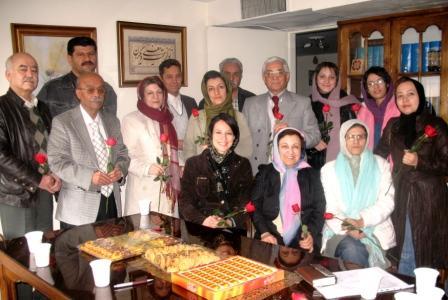
Staff and supporters at the DHRC - Defenders of Human Rights Center Iran

WNN Iran Report - 30 years ago, Dr. Shirin Ebadi, the first female judge in Iranian history, was removed from her post when religious authorities in Iran declared that all women serving in the country as judges were "unfit" to perform their duties. She was then immediately demoted to a position as administrative clerk in the courtroom where she once presided. Dr. Ebadi was hit then by the inequities of women's rights and inequality in Iran, but she did not let that stop her.

During a time marked by political and religious upheaval, Shirin Ebadi found her path and continued her journey by becoming a human rights advocate and attorney serving the public as she helped those who looked to her to provide counsel on the interpretation of rights under the Iranian law.

In 2003, Dr. Ebadi received the Nobel Peace Prize, "for her efforts for democracy and human rights" as she "focused on the struggle for the rights of women and children." Almost six years later, in Feb 2009, the struggle to defend human rights in Iran continues.

"The issues facing us today are increasingly complex. A certain number of states have ignored the rules of international law to impose relations dominated by force. Domestically, repression is increasingly often gaining the upper hand over the respect of rights and freedoms," said Ebadi to human rights defenders, FIDH - International Federation of Human Rights.

Over the past years, Ebadi has been the target of arrests and assassination attempts, but she is not slowing down. She keeps moving forward. Today she continues, in spite of recent reversals, to represent victims of human rights injustice and discrimination.

"I realize that putting so much store in political dialogue seems overly optimistic, given the gulf that exists between the West's expectations of Iran and the Iranian system's inclination to compromise. I focus on the political process not because I imagine we will refashion a new relationship around the negotiating table anytime soon but because I see no other options ahead. Iran, for its part, must peacefully transition to a democratic government that represents the will of the majority of Iranians," said Ebadi in her 2006 book, "Iran Awakening."

Now at the age of 61, her life is in more danger than ever. A sentence for "death" has recently been written by vandals on the walls outside her home and office in Tehran and pinned on her door. But the fearless Iranian human rights lawyer has a deep conviction that, "When you believe in the correctness of your work, there is no reason to be afraid of anything."

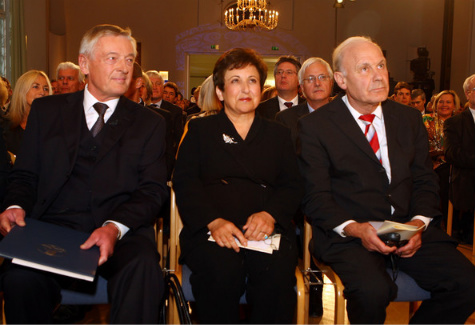
Dr. Shirin Ebadi attending the Tolerance Prize award ceremony where she received recognition

Dr. Shirin Ebadi attending the "Tolerance Prize" award ceremony where she received recognition

Only a few weeks following an invitation to give a series of public lectures for the University of Malaya, the Malaysian Ministry of Foreign Affairs suddenly cancelled Ebadi's speaking tour. "Dr. Shirin Ebadi is a strong critic (of the Iran government)," said the Ministry. "Her public speaking engagements in Malaysia would cause a disruption of the good relations between the governments of Malaysia and Iran, especially in the field of education," continued the Ministry's office.

"On the brink of the 10th anniversary of the UN Declaration of Human Rights Defenders and the 60th anniversary of International Declaration of Human Rights it is ironic that the censure of a 2003 Nobel Peace Prize laureate has occurred in Malaysia.

Following her censored visit to Malaysia, on Sunday, Dec 21, 2008, plain-clothes and uniformed police and security officials raided the offices of Ebadi's DHRC - Defenders of Human Rights Center. DHRC staff speculates that the closure was in part on the heels of the UN General Assembly Oct 2008 negative report on Iran's human rights record.

The subsequent complete closure of the DHRC building in Tehran has come as a very hard blow to human rights defenders worldwide. DHRC cases defending women rights activists, prisoners of conscience, journalists and students in Iran have been compromised, along with DHRC documentation of families of prisoners with reports of human rights abuse. In addition to this, the DHRC committee of investigation on fair elections has completely halted its work for the upcoming April elections in Iran.

"The closure of DHRC is not just an attack on Shirin Ebadi and her Iranian colleagues, but on the entire international human rights community of which she is an influential and important member," said Kenneth Roth, executive director of Human Rights Watch.

As global human rights are also put to the test in the US with possible new policies in the closing of Guantanamo Bay Detention Camp along with government interests in withdrawal of US troops from Iraq, the record of human rights abuse by the US is also in the global public's eye. Speaking up for the greater good is ringing throughout global communities.

"Thirty years on, some of the worst abuses of the Shah's time - torture, executions and the suppression of legitimate dissent - are still being replicated in Iran," said Malcolm Smart, Director of Amnesty International's Middle East and North Africa Program, "despite the efforts of the country's growing and valiant community of human rights defenders."

"It is high time that Iranian authorities lived up to their obligations under international human rights law," added Smart.

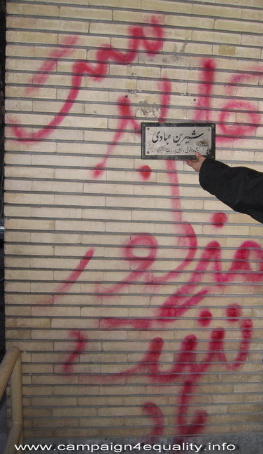
Threatening graffiti on the facade of Shirin Ebadi's office and home. Photo image: Change4Equality

Dr. Ebadi's torn office placard and threatening graffiti on the facade of her office and home. Photo image: Change4Equality.com

On the 30th anniversary of the Iranian revolution, a new and innovative opportunity to address the status of democracy in Iran may be secretly on the mind of many Iranian citizens. Many who participated in Iran's revolution 30 yrs ago had high hopes for freedom and independence, dignity and rights. But the specific hopes and aspirations of Iranian women were shadowed by despair in the early months of the new Islamic Republic.

As new government policies in the post revolution "Spring of Freedom" responded to widespread opposition to the idea of mandatory Islamic dress for women, including requirements to wear the Hijab, relaxation of the codes were not encouraged as Iran's government took a step back only a few months later.

"As long as I am alive, I will do my duty and activities," she said to the press recently.

Exposing Ebadi to higher risks and dangers, her advocacy work on issues related to human rights violations in Iran and her defense in the human rights of Iran's Baha'i community has placed her in an undeserved dangerous and very precarious position.

When Ms. Ebadi received the Nobel Peace prize in 2003, she used the 1.4 million prize money to found and finance the opening of a center for legal rights counsel in Tehran called the DHRC - Defender of Human Rights Center.

Recently, in Feb 2008, Ebadi and her family suffered under the weight of Ebadi's human rights convictions as the government sponsored, IRNA - Islamic Republic News Agency, published a series of articles falsely claiming that she and her daughter, a student at Canada's McGill University, had converted from Islam to a religion currently considered by the Iranian government to be part of a heretical and unrecognized minority - the Baha'i religion.

Leaving the Iranian Islamic State religion is a serious crime in Iran called "apostasy" and being accused of this "crime" cannot be taken lightly. "The penalty for apostasy Kofr (infidelity, blasphemy) under the Iranian criminal code is death," states Section 5, Article 225-1 of the pending Iran State Penal Code.

The drive to formally include apostasy laws and to enact "justice" under the penal code has caused "deep concern" at the United Nations. On the Oct 30, 2008 UN General Assembly's 63rd session, the Assembly expressed concern about Iran "increasing discrimination and other human rights violations against persons belonging to religious, ethnic, linguistic or other minorities." Groups recognized as suffering under the report include Arabs, Azeris, Baluchis, Kurds, Christians, Jews, Sufis and Sunni Muslims, as well as Baha'is and their defenders.

"Particular attacks on Baha'is and their faith in State-sponsored media, increasing evidence of efforts by the State to identify and monitor Baha'is, preventing members of the Baha'i faith from attending university and from sustaining themselves economically," along with Baha'i arrests, were also highlighted by the General Assembly.

Under government scrutiny and the implication in pending Iranian law on the charges of "apostasy," Shirin Ebadi and her daughter are clearly facing personal danger with a looming and dangerously real sentence of death.

She and her daughter promptly denounced these false accusations in public when Ebadi said, "Threats against my life and security and those of my family, which began some time ago, have intensified."  An anonymous, handwritten threat that Ebadi has received during this time says, "Shirin Ebadi, your death is near."

Oct 2008 threats and harassment against Ms. Ebadi escalated while she was in Germany receiving the "Tolerance Prize" from the Protestant Academy of Tutzing. While receiving the prize, the IRNA - Islamic Republic News Agency warned Ebadi that she was not in favour with Iran's government officials as they consider her exploiting Iran's government authority's "patience and tolerance."

This award was ‎bestowed on her because of her remarks that are contrary to the interests of the Iranian ‎nation," stated the IRNA in an accusatory public report.

Since the revolution, 30 yrs ago, the population of Iran has doubled. 70 percent of all Iranians are the same age, or younger than, those who took part in the revolution. Today, these youth are eager to just "live their lives" and be part of the global community. Out of two million students attending higher education, more than 60% today are women. 30 years ago, of the 100,000 students attending institutions of higher education in Iran, only 17.5% were females.

The leadership, creativity and utilization of communication technology by the young women of Iran is setting a vibrant and energetic example for other global social movements.  Iran women are now heralding a new global 21st century women's emancipation.  While in western society, young women are often hesitant to claim the identity, or even use the word "feminism," feminism in Iran has become commonplace in the discourse. Feminism is considered neither taboo nor dreadful.  The creation of online human rights journals, "The Feminist School" and "Campaign for Equality" are two examples of this expanding trend.

Even as a majority of women receive higher education in Iran today, 30 years after the revolution, women still constitute only 15% of the formal paid labor force.  According to the results of the 1385/2006 Iranian census, only 3.5 million Iranian women are salaried workers, compared with 23.5 million men.   Female share of the labor force is less than 20%, considerably below the world average of 45%.

Slightly over half of all teachers in Iran today are women, but the proportion of female university teaching staff is only 20%, less than that of Algeria (41%), Tunisia (40%), Turkey (38%), and Bahrain (36%). To top this off, less than 4% of employed women are found in senior, executive or managerial positions.

The Campaign Against Stoning and All Forms of Violence against Women, The White Scarves Campaign - fighting against gender segregation in Iran stadiums and Kanoon Zanan are all part of a 30 year transcript of a nation where women will no longer take the back seat and accept the inferior position in society.  Iranian women writers, novelists, journalists, publishers and movie directors are defining and redefining gender roles and gender relations on a daily basis.

In a 21st century re-interpretation of 14th century sharia law the Iranian people, and Iranian women in particular, are claiming moral victory and the beginning of real legitimacy.

[Source: Women's News Network at http://womennewsnetwork.net/2009/02/25/moral-victory-of-iranian-women-30-years-after/]